
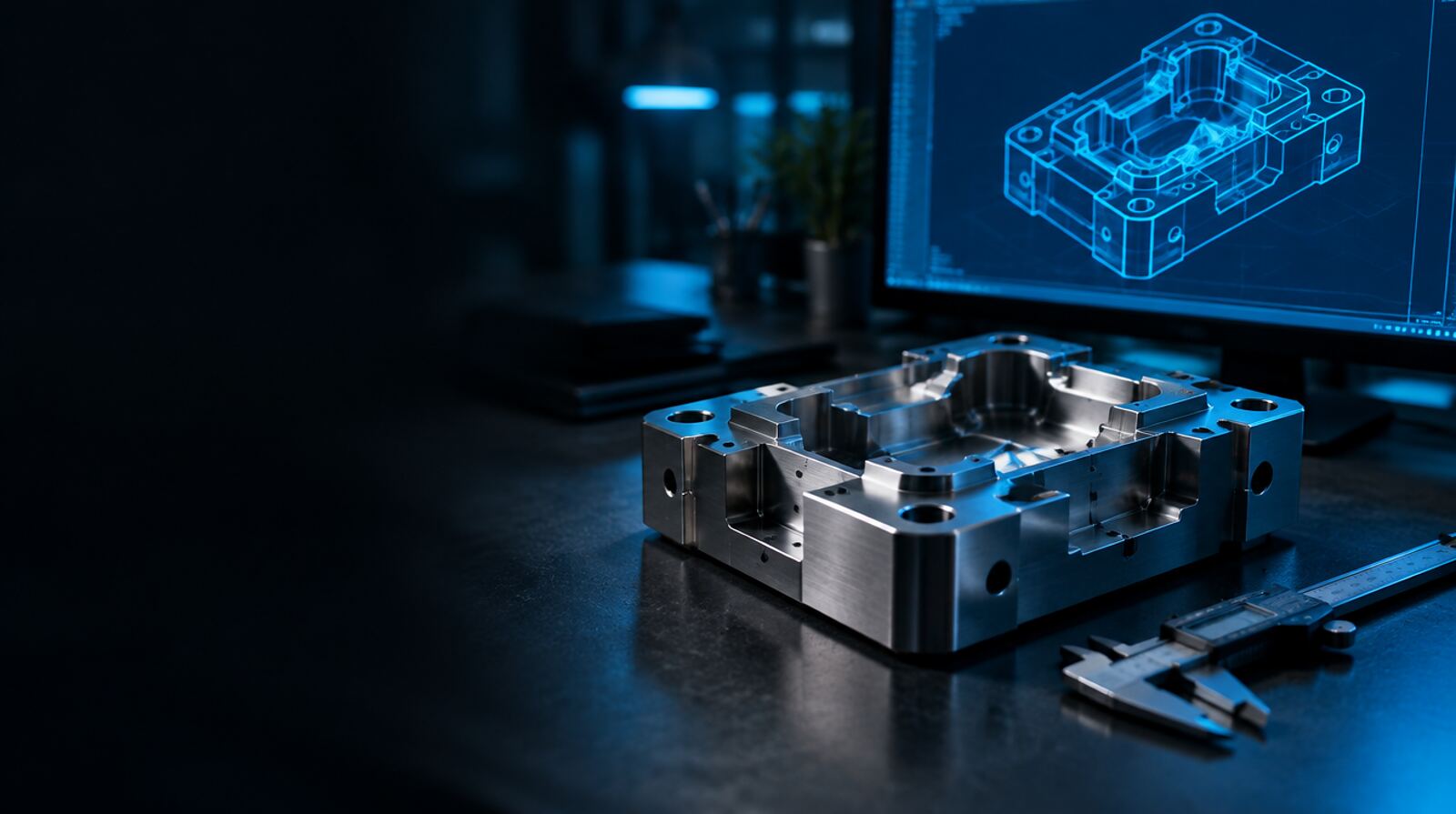
Short answer: send a 3D model (STEP) and a dimensioned 2D drawing (PDF), and state the material and condition, quantity and repeat volumes, surface finish or coating, critical tolerances and the date you need the parts. If you have no drawing, send clear photos with dimensions or the part itself.
Most delays in quoting come from missing information rather than from the pricing itself. When a buyer sends a complete pack, we can review it once, ask few questions and price it accurately. When key details are missing, we either guess, which risks a price that changes later, or go back and forth by email. The checklist below is what we look for when a request arrives in our toolroom.
The quote checklist
| Item | What to send | Why it matters |
|---|---|---|
| 3D model | STEP or IGES (native SolidWorks or Parasolid also fine) | Geometry for CAM programming and time estimates |
| 2D drawing | Dimensioned PDF with title block | Tolerances, threads, finishes and notes |
| Material | Grade and condition, e.g. EN19 condition T | Drives material cost, cutting time and tooling |
| Quantity | Order quantity plus likely repeat volumes | Sets how set-up cost is spread and fixturing planned |
| Tolerances | General tolerance note plus critical dimensions | Tight tolerances add operations and inspection |
| Finish and coating | Surface roughness, heat treatment, plating, anodising | Affects sequence, outside processes and time |
| Critical features | Fits, sealing faces, datums, mating parts | Tells us where precision matters most |
| Delivery | Required date, partial deliveries, collection or courier | Lets us confirm whether the date is realistic |
| Samples or photos | Worn part, mating part, photos with scale | Fills gaps when drawings are missing |
1. A 3D model and a 2D drawing
The combination of a STEP file and a PDF drawing is the fastest route to a firm price.
- STEP (.stp or .step) is the most reliable neutral 3D format. It opens in almost any CAD/CAM system without losing surfaces.
- The PDF drawing carries information a model usually does not: tolerances, thread specifications, surface finish symbols, heat treatment notes, material, revision and quantity.
If the model and drawing disagree, the drawing normally takes priority, but flag it. Check that both are at the same revision before sending.
2. Tolerances that reflect function
Every tolerance has a cost. A general tolerance note, such as a standard ISO 2768 class, covers non-critical dimensions. Then specify tighter limits only where they affect fit or function.
Mark the dimensions that really matter:
- Bearing and bush fits, with the fit designation (for example H7/g6)
- Sealing faces and O-ring grooves
- Locating bores, dowel holes and datums
- Flatness, parallelism or concentricity requirements
Tight tolerances on every dimension tell us nothing about priorities and push the price up. If you are not sure what is achievable, ask. We would rather suggest a practical tolerance before quoting than price an unnecessary one.
3. Material and condition
State the grade and the condition, not just the family. "Stainless" could mean 303, 304, 316 or 431, which machine very differently. "EN19" could be supplied annealed or hardened and tempered.
Useful details include:
- Grade and standard, for example EN24 / 817M40 or aluminium 6082-T6
- Condition or hardness, for example condition T, or 28–32 HRC
- Material certificate requirements, if you need certified material
- Customer-supplied material, if you are providing the stock
If you are unsure which grade to use, describe the load and environment. Our guide to EN8, EN19 and EN24 covers the most common engineering steels.
4. Quantity and repeat volumes
Set-up is often the largest cost on a machined part. Programming, fixture design, tool setting and first-off inspection happen whether you order one part or five hundred.
Tell us:
- The quantity for this order
- Whether the part will be repeated, and roughly how many a year
- Whether you want call-off deliveries from a larger batch
For repeat work, a dedicated fixture can reduce the cost per part, but only if the volumes justify it. See production machining for batch work.
5. Finish, heat treatment and coatings
Outside processes change the machining sequence and the timeline. A part that is hardened after machining usually needs stock left for grinding afterwards. A part that is anodised needs allowance for coating thickness on close fits.
Specify:
- Surface roughness (Ra) where it matters
- Heat treatment: hardening, tempering, nitriding, induction hardening
- Coatings: anodising, black oxide, zinc or nickel plating
- Marking: part numbers, serials or logos, which we can laser engrave
6. Critical features and how the part is used
A short note on what the part does is often more useful than another dimension. "Runs in a bronze bush at low speed" or "seals against a gasket under pressure" tells an experienced machinist where to focus.
If the part mates with others, send the mating part details or the assembly. It helps us check fits and avoid surprises at assembly.
7. Delivery requirements
Give a real required date, not "as soon as possible". It lets us tell you honestly whether the date is achievable and what would change it. Mention partial deliveries, packaging needs and whether you will collect or need courier delivery.
If a line is stopped, say so clearly. Breakdown work is handled differently from planned orders.
8. No drawing? Send a sample or photos
Many of the parts we make have no current drawing. The original supplier has closed, or the drawing was lost years ago. In that case:
- Send clear photos from several angles with a ruler or tape in the shot.
- Add the key dimensions you can measure, and the machine the part comes from.
- Where possible, bring or courier the part itself, ideally with its mating part.
We can measure the part, model it in CAD and produce a drawing for you to keep. See CAD design and reverse engineering.
Common reasons quotes take longer
- No material specified, or only a family name like "mild steel" or "stainless"
- Model and drawing at different revisions, or conflicting dimensions
- Tolerances missing, or tight tolerances everywhere with no indication of priority
- Unclear quantity, especially when repeat volumes would change the approach
- Heat treatment or coating not mentioned until after the quote
- Scanned or low-resolution drawings where dimensions cannot be read
- Complex assemblies or moulds that need design input before they can be priced
Ready to send?
Upload your files through our request a quote form, or WhatsApp photos and drawings to 060 788 1285. Include as much of the checklist as you have. If something is missing, we will tell you what we need rather than guess.
Frequently asked questions
Do I need both a 3D model and a 2D drawing?
Ideally, yes. The 3D model (STEP or IGES) gives the geometry for programming. The 2D drawing carries tolerances, material, finish, threads and notes that a model usually does not. If you only have one, send it and we will tell you what else is needed.
Can I get a quote without a drawing?
Yes. Send photos with a ruler or tape in the shot, key dimensions and a description of how the part is used. For an exact price we usually need to see the part itself, measure it and model it in CAD.
Why does quantity change the unit price so much?
Programming, fixturing and first-off inspection are fixed costs spread across the batch. A single part carries all of that set-up; a batch of a hundred shares it. Telling us your likely repeat volumes helps us plan fixturing and price sensibly.
What tolerance should I put on non-critical dimensions?
Use a general tolerance note, for example a standard tolerance class from ISO 2768, and only tighten dimensions that affect fit or function. Unnecessarily tight tolerances add machining time, inspection and cost.
Which file formats do you accept?
STEP / STP, IGES / IGS, SolidWorks (SLDPRT), Parasolid (X_T), DWG and DXF, and PDF drawings. Photos, hand sketches and physical samples are fine too.
Will my drawings be kept confidential?
Yes. Drawings, models and samples remain your property. We use them only to quote and manufacture your parts, and we do not share them.