One toolroom, every precision process
Precision engineering is the work of turning a drawing, sample or broken part into a component that fits and works first time. Mignon Tools & Dies has done this from Chloorkop, Kempton Park since 1980. The business was founded by toolmakers Werner Peiger and Heinz Wostmann, and the workshop still runs on toolroom habits: measure twice, plan the sequence, and finish critical features last.
Most of our general engineering customers come to us because their part needs more than one process. A shaft may need turning, a keyway milled, hardening, then grinding on the bearing seats. A die insert may need milling, spark eroding of sharp internal corners and surface grinding to final thickness. Because CNC milling, CNC turning, surface and universal grinding, spark eroding, micro welding and laser engraving are all in the same building, the part never leaves our control between operations.
What we make and repair
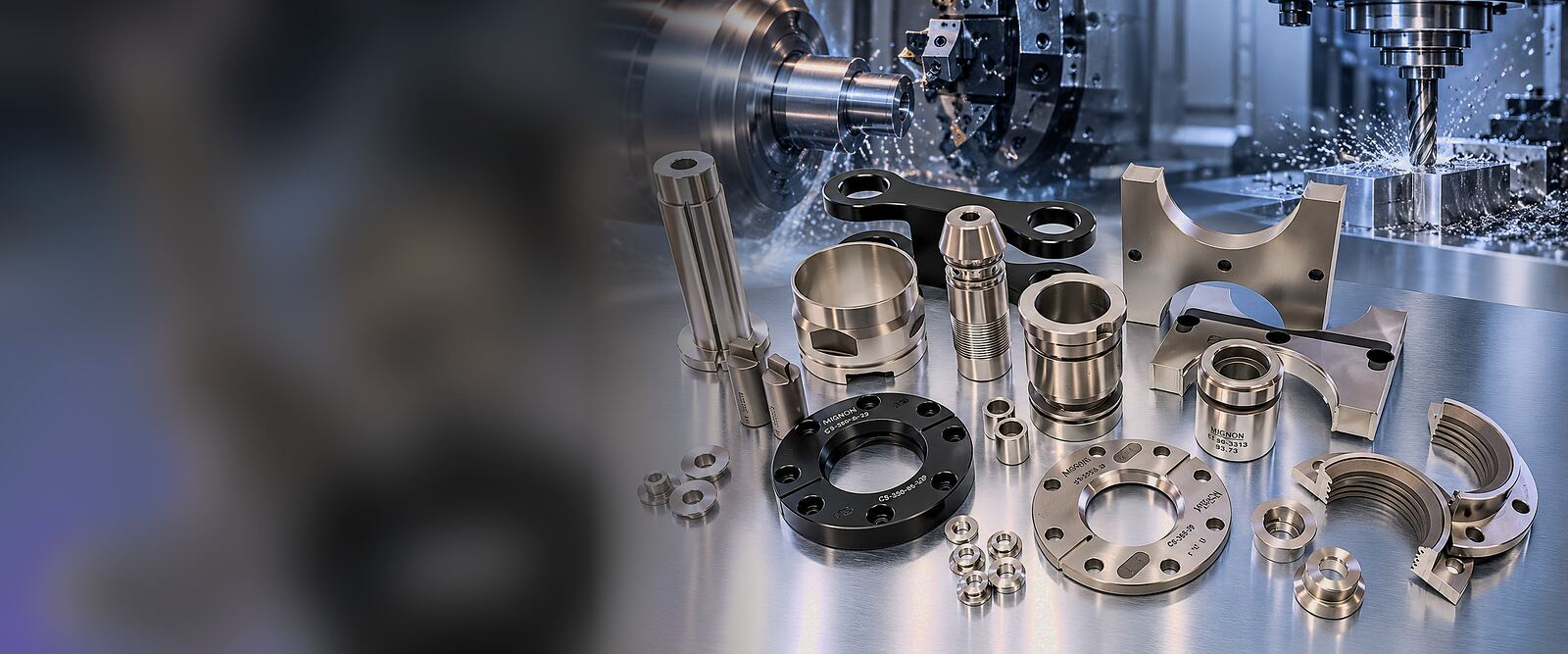
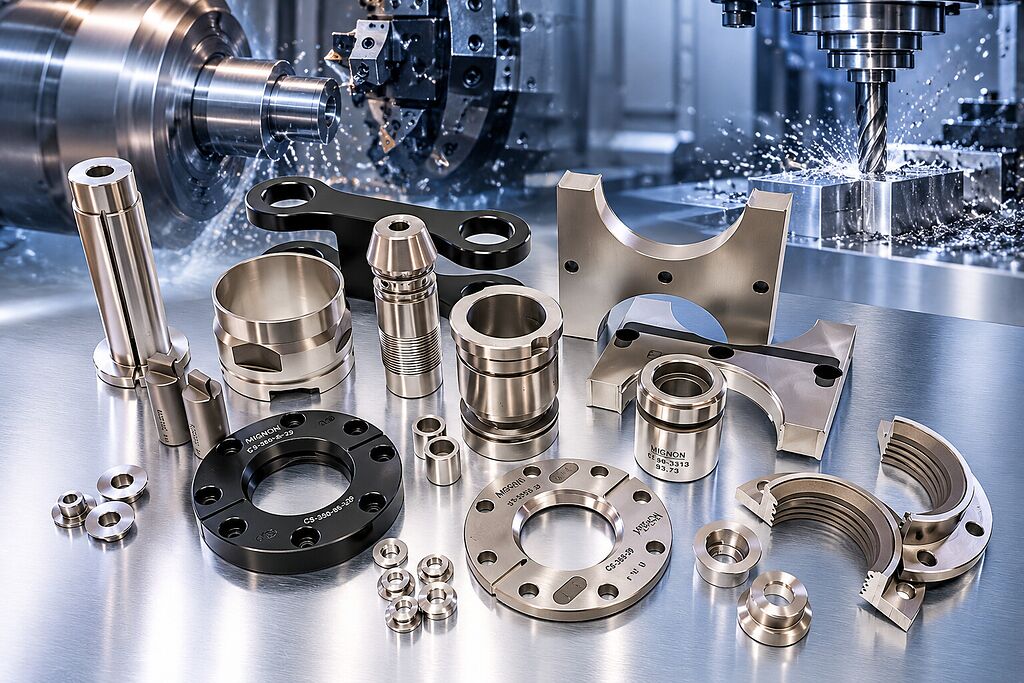
- Replacement parts — shafts, pins, bushes, sleeves, spacers, rollers and couplings for plant and machinery.
- Mould and die components — inserts, cores, ejector parts and die plates, plus repairs to worn tooling.
- Machine and equipment parts — brackets, housings, wear plates and adaptors for mining, rail, food and packaging equipment.
- Prototypes — single parts machined from solid while a design is still being proven.
- Production runs — repeat components made with proven programs and fixtures. See production manufacturing.
- Jigs, fixtures and gauges — workholding and go/no-go gauges for your own production line.
Combining processes on one part
The order of operations decides whether a part ends up on size. A practical example is a hardened shaft. We turn it from EN19 or EN24 with grinding stock left on the bearing seats, mill any keyways or flats, send it for hardening and tempering, then grind the seats to final size. Grinding after heat treatment removes the distortion that hardening always introduces.
Spark eroding fits into the same thinking. Hardened tool steel cannot easily be cut with a milling cutter, and a cutter cannot make a sharp internal corner. Where a design needs either, we rough-machine soft, harden, then spark erode the final detail. Where only a small edge is worn or chipped, micro welding can rebuild it before the area is re-machined or ground.
Breakdown work and replacement parts
When a line stops, the cost of waiting is usually far higher than the part itself. We treat breakdown work as a priority. Bring in the damaged component, or send clear photos and dimensions on WhatsApp to 060 788 1285, and we will assess it the same day. Often the fastest route is to measure the old part and make a new one, sometimes with an improvement such as a harder material or a better fillet radius where the original cracked.
Where a part is worth saving, repair is often cheaper than replacement. Worn bores can be sleeved, damaged edges rebuilt by micro welding, and worn diameters ground back to a clean undersize with a matching bush.
Materials and finishing
We machine tool steels such as D2, H13 and P20, engineering steels including EN8, EN19 and EN24, stainless steels from 303 to 17-4PH, aluminium, brass, bronze, copper alloys and engineering plastics. If your drawing calls for a material that is hard to source locally, we will suggest an equivalent and explain the trade-off.
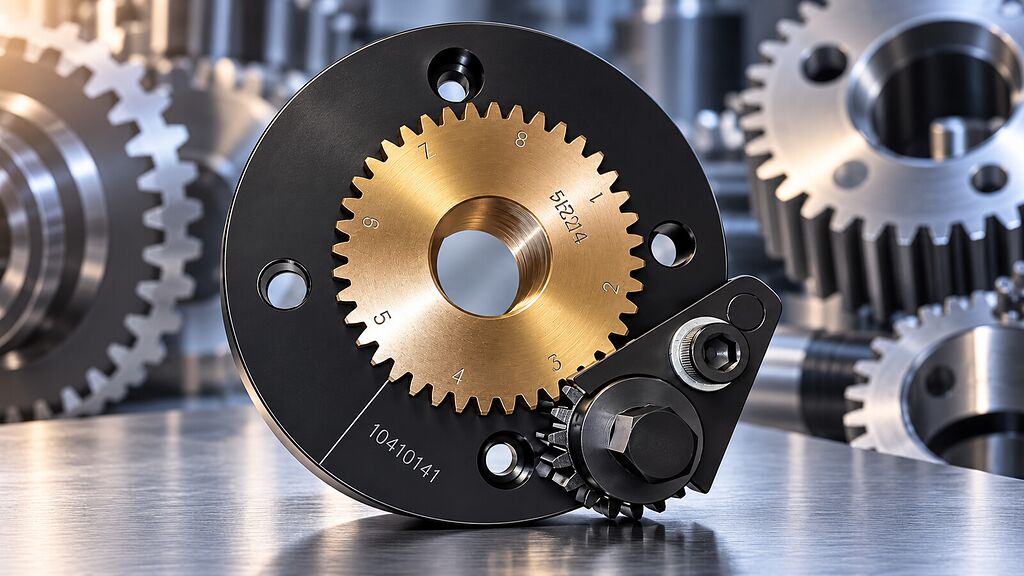
Parts can be laser engraved with part numbers, serials, logos or QR codes on flat or cylindrical surfaces, which makes spares easier to identify and trace.
Why manufacturers choose Mignon
- Toolmaker accuracy — more than 46 years of making moulds, dies and precision parts.
- All processes in-house — milling, turning, grinding, spark eroding, micro welding and engraving under one roof.
- Practical engineering advice — we flag tolerances, materials and features that drive cost before we cut metal.
- Breakdown response — urgent work is assessed the same day.
- Easy to reach — Chloorkop, Kempton Park, close to OR Tambo with quick access from Johannesburg, Pretoria and the East Rand.