
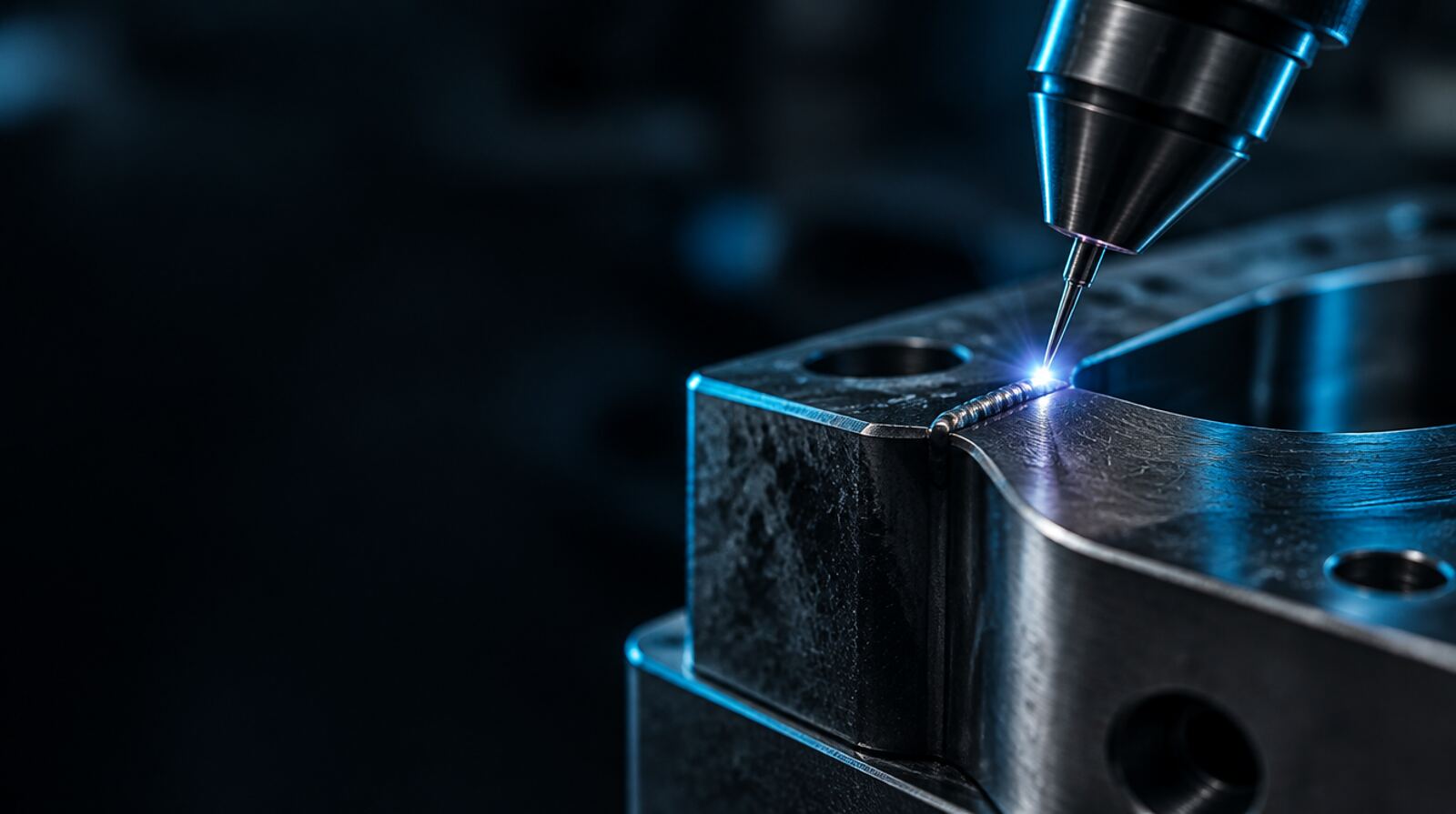
Precision repairs without distortion
Micro welding is how a toolroom repairs damage that is too fine for conventional welding. Mignon Tools & Dies uses it for precision part repair. Small, consistent spot welds penetrate the surface and rebuild missing material exactly where it is needed. We weld copper, beryllium copper, stainless steel, brass, aluminium and tool steel, the metals most moulds, dies and precision parts are made from.
Because CNC milling, spark eroding, grinding and polishing are all in the same workshop, a welded area is re-machined to its original geometry straight away. You receive a repaired component, not just a weld.
Low heat input compared with TIG
Conventional TIG welding uses a relatively large arc and a lot of heat. On a mould insert or die, that heat spreads into the surrounding material. It can soften pre-hardened steel, temper hardened steel, distort thin sections and cause cracking in the heat-affected zone. Aluminium and copper alloys conduct heat so well that the effect spreads even further.
Micro welding keeps the heat local. Each weld is small and controlled, the heat-affected zone is narrow, and the part stays close to its original shape and hardness. The process we use is micro TIG welding.
What we repair
- Mould and die edges. These include chipped cavity edges, rounded cutting edges and damaged corners.
- Parting-line damage. Dents from trapped parts or mishandling cause flash on every shot.
- Worn shut-offs. Where core and cavity meet, wear lets plastic flash through.
- Blow mould pinch-offs and neck inserts. These are repaired in BeCu and aluminium. See blow mould repair.
- Engraving changes. We fill old lettering or logos so new markings can be added.
- Machining errors and design changes. We add material back to correct a mistake or change a feature.
Re-machining and re-polishing after welding
A weld is only the first step. We machine it back to the original geometry by milling, spark eroding or grinding, depending on the feature and the steel's hardness. We then blend and polish the surface to match the surrounding cavity, from a mirror finish to a spark-eroded texture. Parting lines are checked against the mating half so the mould seals correctly.
Getting a reliable weld repair
- Know the base material. Matching filler to the base steel or alloy gives the best colour match after polishing and the right hardness.
- Pre-heat when needed. Some hardened tool steels need pre-heat and post-weld tempering to avoid cracking.
- Clean the area properly. Plastic residue, rust preventive and oil in the weld zone cause porosity.
- Repair early. A small dent repaired now is cheaper than a large one after weeks of flashing and further damage.
For injection mould and blow mould breakdowns, call or WhatsApp 060 788 1285. We assess urgent work the same day.